
July 13, 2026
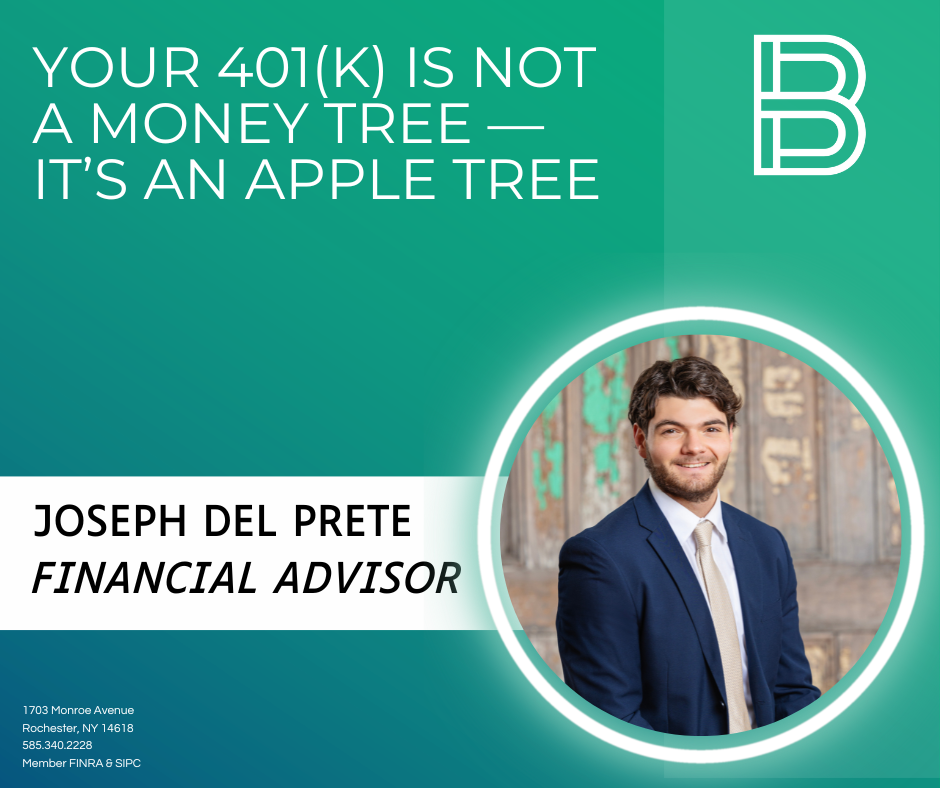
For a long time, retirement in Rochester looked different than it does today.
Many families had someone who worked at Kodak, Xerox, Bausch + Lomb, Paychex, or another major local employer. You put in your years, built a career, and in many cases had some form of steady retirement income waiting on the other side.
That structure gave retirees something incredibly valuable: predictability.
To be clear, pensions have not disappeared entirely. Many school districts, municipalities, and certain state jobs still offer pension benefits. But in much of the private sector, the retirement responsibility has shifted. For many workers today, the 401(k), 403(b), IRA, or Roth IRA has become the primary retirement vehicle.
And that changes everything.
A pension is designed to create income. A 401(k) is simply an account. It does not automatically know how much you need each month, when taxes should be managed, whether Social Security should be delayed, or how withdrawals should be handled during a rough market.
That is now your responsibility.
No pressure, right?
I often compare retirement accounts to growing an apple tree. During your working years, you spend most of your time planting, watering, and caring for the tree. Every contribution into your 401(k), IRA, or Roth IRA strengthens the roots. At first, it may not feel like much is happening. You are saving, staying disciplined, and wondering if it is really making a difference.
But patience is a virtue.
Over time, the tree grows. It becomes stronger. Eventually, if cared for properly, it begins producing apples. Those apples are the income your retirement savings can provide later in life.
That is the entire point of the tree.
But once the apples start growing, you still need a harvesting plan. You do not want to strip the tree bare and eat every apple at once. If you take too much too quickly, you risk damaging the tree and reducing what it can provide in the future.
At the same time, you do not want to let every apple fall to the ground and rot because you were too afraid to use what you worked so hard to grow.
There has to be a balance.
That balance is retirement income planning.
Saving money during your working years is one challenge. Turning that money into reliable retirement income is another. Accumulation and distribution are two completely different games.
During your career, the focus is usually straightforward: save consistently, invest appropriately, and allow time to work. In retirement, the questions become more personal and more technical.
How much should I withdraw each year? Which account should I use first? How do I manage taxes over time? When should I take Social Security? What happens when required minimum distributions begin? How do I avoid selling investments at the wrong time during a market decline?
These are not small questions.
A thoughtful distribution strategy should consider your essential expenses, lifestyle goals, healthcare costs, inflation, taxes, and legacy wishes. It also needs to be flexible. Retirement is not one decision made on the day you stop working. It is a series of decisions made over many years.
Markets change. Interest rates change. Tax laws change. Family needs change. Health changes. Life changes. Your plan has to be able to move with it.
Taxes are one of the biggest reasons this matters. Withdrawals from traditional 401(k)s and IRAs are generally taxed as ordinary income. Roth accounts may provide tax-free withdrawals if certain rules are met. Brokerage accounts may receive capital gains treatment. Social Security may become partially taxable depending on income. Required minimum distributions eventually enter the picture.
The order in which you harvest the apples matters.
Sometimes it may make sense to use taxable assets first. Sometimes IRA withdrawals may be appropriate. Sometimes Roth conversions may help reduce future tax pressure. Sometimes delaying Social Security can be valuable. Other times, it may not be.
There is no one-size-fits-all answer.
Here in Rochester and Western New York, I meet many people who did the hard part well. They worked, saved, contributed to retirement plans, paid down debt, and built real assets. But many were never shown how those assets are supposed to work together once the paycheck stops.
That is the missing piece.
A 401(k) is not automatically a retirement plan. It is a retirement account. The plan is how you use it.
The old company pension gave retirees a built-in paycheck. With a 401(k), you have to create that paycheck yourself.
That requires more than guessing. It requires a thoughtful distribution plan, a clear understanding of taxes, and ongoing adjustments as markets, laws, and personal circumstances change.
This is where guidance from a financial professional can be valuable. A strong retirement income plan should look beyond one account or one investment and consider taxes, income needs, market risk, and the full financial picture.
If your 401(k) is now your apple tree, it deserves to be treated like one: grown with patience, harvested with care, and protected with a real plan behind it.
Joseph Del Prete
Financial Advisor
E-Mail: jdelprete@brightonsecurities.com
Direct: 585.340.2228